

By David Sweetnam, Director of Lab Services, EMEA/APAC at Keypoint Intelligence
Check out the Keypoint Intelligence Robotics landing page!
For decades, robotics investment has followed a predictable global pattern. High labor costs in Europe, Japan, and North America make automation an easy sell when manufacturing high-value goods like cars and consumer electronics. Low-cost labor markets, by contrast, have traditionally sat outside the core target audience for robotics vendors, with the assumption that low-manpower-cost manual processes are simply “good enough” and the ROI calculations simply do not work out.
Watch the following Print Media Youtube video: https://www.youtube.com/@PrintMediaIndonesia
However, spend time talking to innovators in India’s textile industry, and you start to see a different mindset taking root.
I conducted a series of interviews with senior executives across India’s textile, print, and automation ecosystem that revealed a very different reality. Here, the rise in robotics investment is not being driven by labor cost reduction. Instead, it is being adopted as a response to skills shortages, quality consistency, workforce retention, and the growing difficulty of scaling production without introducing costly errors.
“People assume labor is unlimited in India,” says Mr AD Navaneeth, CEO of Retro Robotix, a company that specializes in providing robotics solutions to various industries across India. “But on the factory floor, especially in textile hubs like Tirupur, we are already facing a serious manpower shortage.”
As education levels rise and career opportunities expand, fewer workers are willing to take on repetitive, physically demanding shop-floor roles. Textile manufacturing still requires people on the ground, but finding and retaining staff willing to perform monotonous tasks over long shifts has become increasingly difficult.
“Once people are educated, they don’t stay in these roles,” Navaneeth explains. “They move on to other industries. Textile still needs floor workers, but availability is no longer guaranteed.”
This shift has fundamentally changed how automation is viewed. Rather than being positioned as a tool for workforce reduction, robotics is increasingly seen as a way to stabilize production, protect quality, and make better use of existing staff.
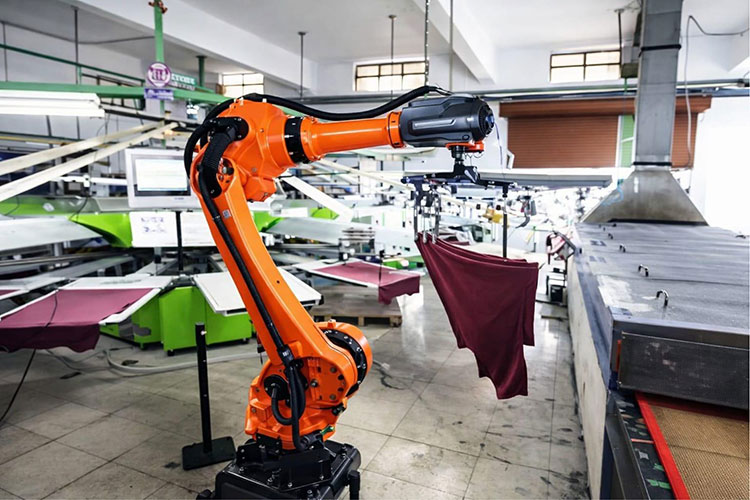
CAPTION: RetroBot, from Retro Robotix, being demonstrated at the RDX Digital booth at The Knit Show in Tirupur in 2025.
For Deepak Siddharth K, Founder of RDX Digital Technologies, a manufacturer of digital textile printing presses headquartered in India, the quality argument is central.
“When I was running printing operations myself, the biggest cost wasn’t labor,” he says. “It was errors. Losing even a small percentage of output every day because of fatigue or repetitive mistakes adds up very quickly.”
Many of the most damaging production errors occur during mundane tasks such as unloading garments, transferring items between stations, or visually checking prints for consistency. These are simple processes, but over time they are highly susceptible to fatigue and inattention.
“Robotics removes that inconsistency,” Siddarth says. “The goal is not fewer people. The goal is fewer defects.”
At Retro Robotix, that philosophy has shaped product development from the outset. Rather than chasing fully autonomous factories, the company has focused on automating tasks where humans add the least value.
“Robots are ideal for dull, repetitive work,” says Mr. Eswaravel Ekambaram, Co-Founder and Chief Production Officer of Retro Robotix. “These are jobs where people get tired, distracted, or physically worn down, and that’s when quality problems start.”
By automating processes such as garment unloading and handling around curing tunnels, manufacturers can redeploy experienced staff into roles that involve supervision, optimization, and problem-solving.
“This is not about removing skilled people,” Ekambaram adds. “It’s about using them in the right places.”
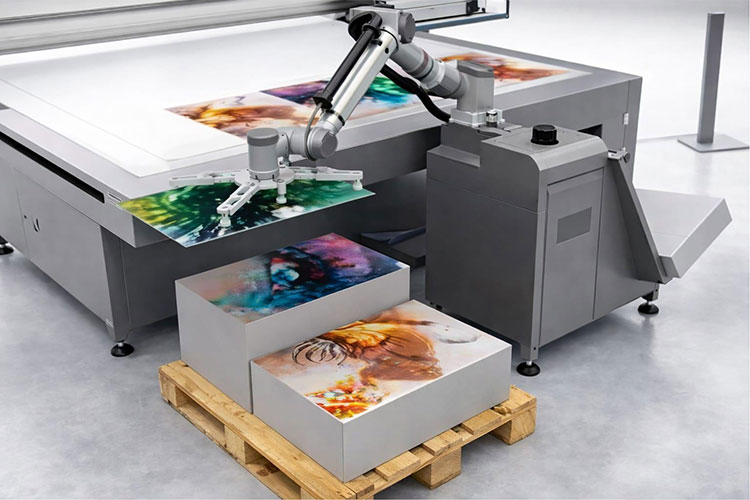
CAPTION: A RetroBot installed at Stamppa Digital Prints in Tirupur.
That approach is already delivering tangible results at Stamppa Digital Prints, where robotics has been integrated into live production.
“For us, robotics is about control and consistency,” says Arun Balaji, Managing Partner at Stamppa Digital Prints. “People get tired. A robot doesn’t.” Balaji has installed Retro Robotix’s latest six-Axis robot to unload printed garments from the press and place on the drying tunnel. The RetroBot can conduct this task at 450-500 garments per hour, 24/7.
Crucially, Arun is clear that automation has strengthened rather than weakened his workforce.
“We don’t want our best people unloading shirts all day,” he explains. “We want them focused on color accuracy, value-added effects, and customer-specific work. That’s where revenue is generated.”
By removing monotonous tasks from the workflow, Stamppa has been able to shift staff into more interesting, higher-value roles while simultaneously improving output consistency and reducing rework.
This leads to a very different ROI conversation than is typical in higher-wage markets. In India, robotics ROI is rarely justified by labor replacement alone. Instead, the return comes from reduced waste, fewer rejected orders, and improved customer confidence.
“When a customer rejects part of a shipment, you lose more than garments,” Arun notes. “You lose time, trust, and future business.”
Viewed through that lens, robotics becomes a form of risk management rather than a blunt cost-cutting exercise.
Keypoint Intelligence Opinion
What emerges from these conversations is an industry quietly redefining where automation belongs. India’s textile sector may still be globally competitive on labor cost, but expectations around quality, reliability, and scalability are rising fast.
As Navaneeth puts it: “This is not about replacing people. It’s about building factories that can grow without breaking.”
For a market long assumed to be on the fringes of automation, that shift in mindset may prove to be the most important innovation of all.
With much of the massive global textile industry centred in low-cost workforce regions, the opportunity for robotics companies could be immense, and the early adopters who see beyond the staff reduction-focused ROI approach look set to be the big winners in this textile manufacturing evolution.
Keypoint Intelligence is conducting an extensive survey looking into the adoption of robotics in the printing industry, some of the early results make for very interesting and at times surprising reading. For more information, visit our latest information on Robotics here, Testing, and Textile and Apparel here.
David Sweetnam, Director of Research and Lab Services EMEA/Asia
David has over 21 years of experience in the imaging industry, spanning lab analysis, research, and technical services roles in the USA and Europe. He established Keypoint Intelligence’s European lab in 2007 and has led its growth ever since. Earlier in his career, he advised corporate and public sector clients on office imaging and software solutions. David holds a Bachelor of Science in Chemistry from the University of Reading.
………………………………..
Fully contained in Indonesia Print Media magazine edition 129 March-April 2026
Get the latest Print Media magazines and Newsletters through the following link: https://anyflip.com/homepage/wuzhb
PRINT MEDIA INDONESIA
E : info.indoprintmedia@gmail.com
M/WA : +62 811 808 282